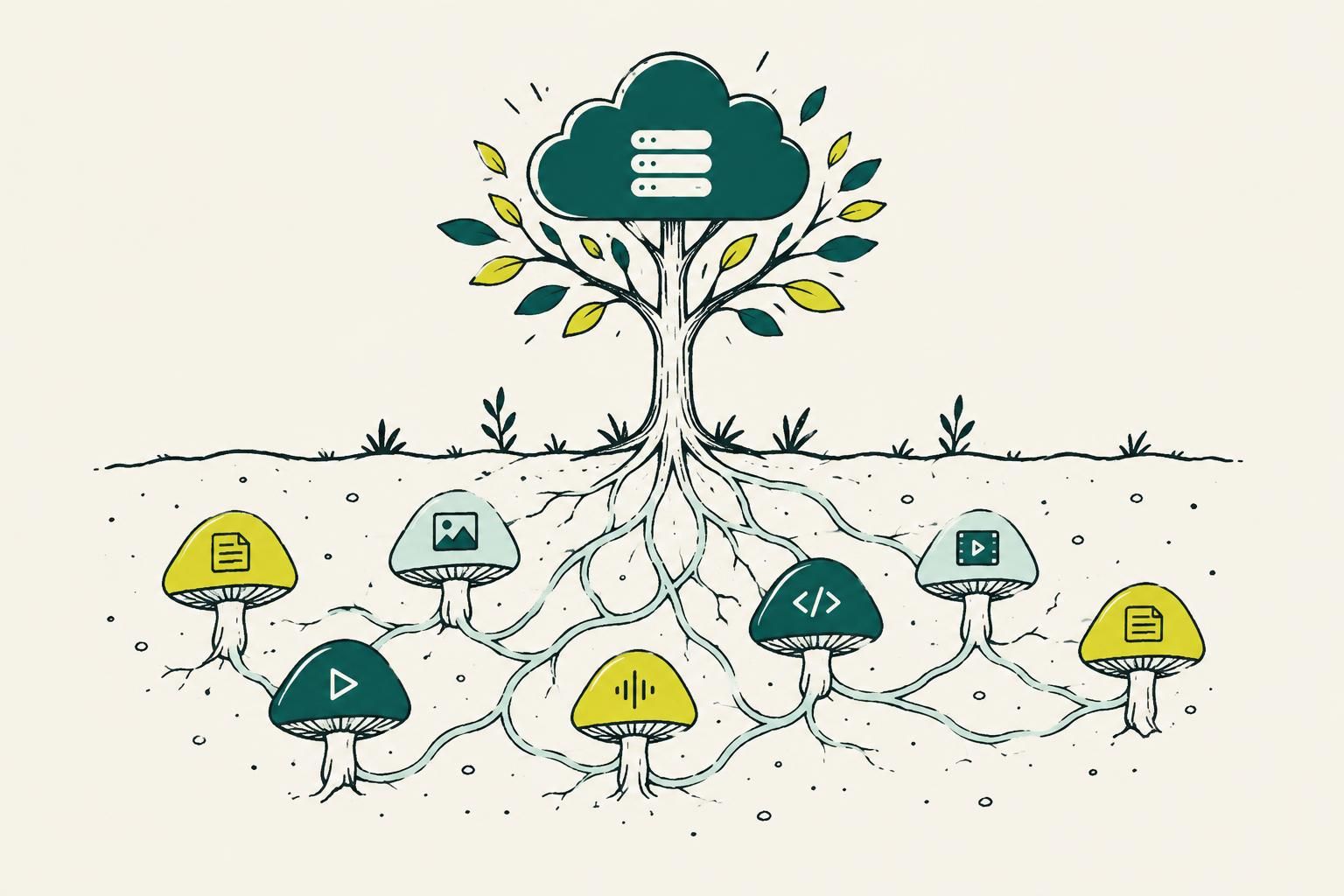
A useful content strategy gives every article, page, email, and campaign a job. For SaaS teams, that job is usually to help a specific buyer make progress toward a trial, demo, or purchase, then improve the system as evidence accumulates.
What is content strategy?
Content strategy is the operating plan for using content to achieve a business outcome. It sets the audience, problems to address, messages to earn, formats to use, distribution routes, production process, and measurements that decide whether the work continues.
It is not a topic list or a publishing calendar alone. A calendar says what goes live. A strategy explains why that item deserves resources, who it serves, what action it should support, and how the team will learn from the result.
Why a documented content strategy matters for SaaS teams
Undocumented content tends to follow the loudest request: a founder's idea, a competitor's latest post, or a keyword with a large number beside it. That creates activity, not necessarily an acquisition asset. A documented strategy lets a small team decline work that does not connect to a buyer, product narrative, or conversion path.
It also makes content easier to compound. One strong decision guide can support product pages, sales conversations, onboarding, comparison material, and follow-up emails. For the broader acquisition system around it, use this SaaS digital marketing guide to connect content with the other channels that create demand and capture it.
The core principles of a content strategy that can compound
- Start with a business outcome. Define the conversion or customer behavior the work should influence.
- Serve a real decision. Write for the question a buyer needs answered, not for a vague demographic label.
- Earn attention with proof. Use product knowledge, firsthand experience, clear examples, and cited claims where claims matter.
- Build connected assets. Pillars, supporting articles, product pages, and internal links should make the next useful step obvious.
- Run a repeatable editorial system. A dependable brief, review, publishing, and measurement loop beats bursts of inspiration.
- Treat published content as inventory. Improve, consolidate, redirect, or retire work based on evidence rather than attachment.
Start with the business outcome and the conversion path
Pick one primary outcome for the next planning period: qualified trials, demo requests, activated users, expansion conversations, or lower sales friction. Then map the path backward. What does a buyer search, compare, need to understand, and need to believe before that outcome is realistic?
For example, a workflow tool selling to operations leads could map a path from “how to standardize approvals” to a workflow template, then to a product page showing approvals in use, then to a trial. The content is not successful merely because it attracts readers. It is successful if it moves the right reader to the next step.
Define the audience by buying context, not a generic persona
“Marketing managers at startups” is too broad to guide an article. Define the moment instead: a founder preparing to launch, a team replacing a spreadsheet process, or a technical lead assessing an integration. Each has different urgency, vocabulary, objections, and proof requirements.

For every priority audience context, record the trigger, desired outcome, alternatives, perceived risk, and next action. This turns audience research into editorial choices. A reader evaluating alternatives needs comparison criteria. A reader learning a new workflow needs an explanation and an example.
Create a message architecture before you create a topic list
A message architecture is a short hierarchy of what your company wants to be known for and the evidence that supports it. It keeps articles from becoming disconnected answers that could have been written by any competitor.
- Core promise: the outcome your product helps a buyer achieve.
- Customer problems: the costly or frustrating situations behind the search.
- Differentiated approach: how you frame solving those problems.
- Proof: product capabilities, processes, examples, customer evidence, or documented facts you can substantiate.
- Boundaries: promises you will not make and audiences you do not serve.
Keep this document usable. A founder and writer should be able to use it to decide whether “best project management software” belongs in the plan, or whether a narrower operational problem is more credible and commercially relevant.
Audit what you have before you plan what to publish
Inventory existing blog posts, product pages, templates, documentation, case material, emails, and sales enablement. For each asset, record its audience context, intent, business role, current evidence, owner, and next decision: keep, refresh, merge, redirect, or retire.
Look for overlap before creating more. Two articles answering nearly the same question divide editorial effort and confuse the internal linking structure. Look for pages with a useful premise but stale examples, weak proof, or an unclear next step. If traffic has fallen, follow a structured website traffic drop recovery plan before assuming that publishing more is the answer.
Find content opportunities at the intersection of demand, intent, and proof
Prioritize opportunities only when three conditions meet. There must be a discoverable question or distribution opportunity, an intent that connects to your business, and proof that lets you make a better page than a generic summary.
Demand without intent creates vanity traffic. Intent without proof creates thin content. Proof without demand can still be valuable for sales or customer education, but it should not automatically become an SEO priority. Score each proposed item for buyer proximity, relevance, proof, conversion fit, and production effort.
For buyer-search-focused planning, this SEO content marketing guide for SaaS explains how intent, trust, and growth fit together.
Build content pillars and topic clusters around real decisions
A content pillar is a durable business problem your product is qualified to discuss. A cluster is the set of focused pages that answer the decisions within that problem. Build clusters around jobs a buyer must complete, not around broad industry jargon.
For example, a SaaS product serving support teams could build a pillar around improving support operations. Supporting pages might cover choosing a workflow, measuring resolution quality, documenting escalation rules, comparing approaches, and implementing a process. Each page should link to the next question naturally, while the pillar establishes the complete frame.
Choose content formats based on what the reader needs to decide
Do not default to blog posts. Use the format that reduces the reader's uncertainty. A guide explains a process. A checklist supports execution. A template gives a starting point. A comparison frames a choice. A case example demonstrates proof. A product page clarifies fit. Documentation helps a user complete a task.
Use an article when the buyer needs context, criteria, or a method. Use a landing page when the buyer is already evaluating a solution. For pages that need organic discovery and conversion, technical foundations matter too. Review this technical SEO guide for SaaS pages alongside the editorial plan.
Turn priorities into briefs, a calendar, and a production workflow
Every priority item needs a brief before drafting begins. Include the buying context, reader question, intended action, search intent, key points to cover, evidence required, internal pages to link, product boundaries, reviewer, and publish date. The brief is where strategic decisions become repeatable editorial work.

Build the calendar around capacity and dependencies, not arbitrary posting frequency. Schedule foundational pages first, then supporting pieces that can link into them. Leave room for refreshes and product launches. A smaller calendar that is researched, edited, and connected will outperform a large queue nobody can review.
Decide what to build in-house, automate, or outsource
Keep message architecture, product truth, customer insight, and final commercial judgment close to the team. These are difficult to delegate because they depend on lived context. Standardize repeatable tasks such as research collection, brief assembly, formatting, internal-link checks, and reporting.
Outsource when specialist execution is the constraint, not when the strategy is undecided. A partner needs clear access to product knowledge, approval rules, and success measures. If you are comparing operating models, see this guide to content marketing agencies and services for SaaS and app companies.
Automation tools differ sharply in operating model. TheSEOAgent advertises 30 articles/month for $99/month per paid site and native publishing to WordPress, Webflow, Shopify and Ghost. RankYak Pro costs $99 per site/month or $990/year and permits one article per chosen publishing day, about 21/month for weekdays or about 30/month for every day. Machined’s $19/month Launch plan includes 30 articles, while its $99/month BYOK plan allows up to 2,000 articles/month plus separately billed model-provider costs. Sorank’s annual Essential plan is listed at $49/month and includes 20 articles/month, 25 tracked AI prompts and approximately 400 discovered keywords/month. Choose software for its fit with your review capacity and publishing setup, not because its article count is high.
Plan editorial quality control and governance before publishing at scale
Quality control is a system, not a final spellcheck. Set acceptance criteria for factual claims, source handling, product statements, originality, structure, accessibility, metadata, links, and calls to action. Name the accountable reviewer for each category.
Create a claims policy. Writers should distinguish product facts the team has verified, externally sourced facts that need a citation, and editorial judgment that should be presented as judgment. Add a review route for regulated, security, financial, or integration claims. Governance protects trust while letting production move.
Publish in a way that supports discovery and conversion
Publishing is the handoff from editorial work to a usable asset. Give each page a clear title, descriptive metadata, a purposeful URL, relevant internal links, and a next step that matches its intent. A top-of-funnel guide should not pretend the reader is ready for a sales call. It can offer a related template, product explanation, or deeper decision guide.
Make ownership explicit after publication. Someone should check that the page renders correctly, is included in the sitemap where appropriate, has working links, and is connected to relevant pages. A publish button is not a content distribution strategy.
Distribute and reuse each asset without diluting its purpose
Start with the original asset's job. A detailed guide can become a short founder post, a sales follow-up, a customer newsletter section, a webinar outline, or several social observations. Each derivative should stand on its own and lead back to the deeper resource only where that is useful.
Do not duplicate the article verbatim across channels. Extract one useful idea for each setting. A distribution plan should specify the audience, angle, owner, timing, and desired action for every reuse, otherwise “repurposing” becomes a pile of low-context fragments.
Measure content strategy with a scorecard tied to business outcomes
Use a scorecard with leading and lagging measures. Leading measures show whether the system is functioning: priority pages published, pages refreshed, indexing status, qualified impressions, clicks, and engagement with the next step. Lagging measures show business impact: assisted trials, demos, activated accounts, influenced pipeline, or retained customers.
Review results by cluster and intent, not only page by page. A comparison page may have modest traffic and still be commercially valuable. A broad informational post may bring clicks without bringing qualified readers. Tag conversion paths so the team can distinguish attention from progress.
Maintain the strategy: refresh, consolidate, and stop low-value work
Set a recurring maintenance cycle. Refresh pages whose examples, product details, or evidence have changed. Consolidate overlapping pages into a stronger resource. Redirect retired URLs when a relevant replacement exists. Stop producing formats and topics that repeatedly fail their stated job.

This is also where strategy becomes more precise. Search and conversion data reveal which questions are worth deeper coverage, which messages resonate, and where the path breaks. Treat updates as planned work, not as an emergency response to a declining graph.
Where a managed SEO content partner fits in this strategy
A managed partner fits after you have defined the buyer, conversion path, message boundaries, and approval standard. It is most useful when a founder-led SaaS team has strong product knowledge but lacks the time or in-house operation to consistently research, write, edit, publish, and improve buyer-intent SEO articles.
SEO for SaaS is a SaaS SEO content service for that operating gap. It selects topics from the site or app listing plus keyword data, produces researched, cited, fact-checked articles, and supports schema markup, internal linking, sitemap work, and Google Search Console monitoring. When a post loses clicks, it can be rewritten on the same URL.
It suits teams with custom blogs especially well. Published articles are delivered through a read-only API, with signed webhooks for publish, update, and unpublish events, and the service supplies guides for Next.js App Router and Astro. Your own site renders the structured content in its design. This is not a hosted blog theme or a WordPress-only publishing model.
A practical 90-day content strategy plan for an early-stage SaaS
- Days 1 to 30: choose one business outcome, map one buyer conversion path, write the message architecture, and audit existing assets. Select one or two pillars with a defensible connection to the product.
- Days 31 to 60: create briefs for the pillar and its first supporting pages. Publish the foundational assets, connect them internally, and establish a review checklist and scorecard.
- Days 61 to 90: publish the next cluster items, distribute the strongest pieces through owned channels, inspect discovery and conversion signals, then refresh or revise the weakest links in the path.
Keep the first quarter narrow. One coherent cluster with clear conversion paths is a better learning system than dozens of loosely related posts. Budget for the process deliberately as well. This SaaS content marketing budgeting guide can help frame the costs of production, editing, and maintenance.
Content strategy FAQ
What are the core principles of content marketing?
The core principles are audience relevance, a clear business purpose, useful and credible information, consistent execution, connected conversion paths, and ongoing measurement. Good content marketing helps a defined reader make progress while advancing a defined business goal.
What are the five components of a content strategy?
A practical five-part model is: business outcome, audience and buying context, message architecture, content and distribution plan, and measurement plus maintenance. Together, these components explain what to create, why it matters, how it reaches people, and what happens after publication.
What are the seven most commonly used branding strategies?
There is no single universally accepted set of seven branding strategies. One useful working set is purpose-led positioning, category positioning, audience-segment positioning, problem-solution positioning, price-value positioning, product-led branding, and founder- or expert-led branding.
What are the seven main types of content?
A useful seven-format set is articles, landing pages, case examples, templates and tools, videos, email, and documentation. The best format depends on the decision a reader needs to make. Use a guide for understanding, a template for action, a comparison for evaluation, and documentation for implementation.