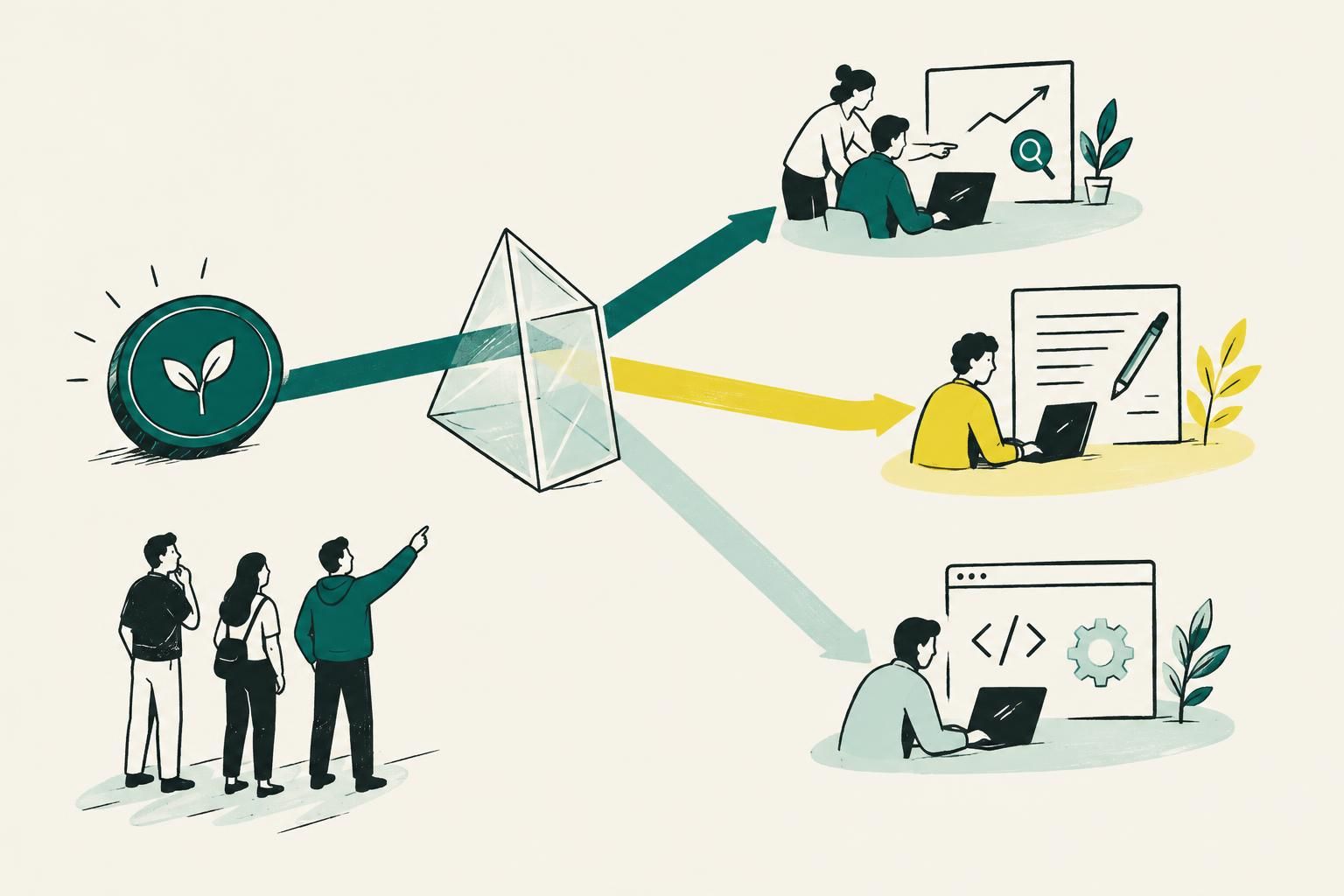
ICP marketing turns a vague target market into a repeatable set of choices: who to pursue, what problem to lead with, which channels deserve investment, and which prospects to decline. For SaaS teams, a useful ideal customer profile is not a slide. An ICP can serve as an operating framework for targeting, qualification, messaging, and channel choices; whether it improves acquisition quality or retention should be demonstrated with the company’s own segment-level results.
What ICP marketing is and what it is not
ICP marketing is the practice of designing marketing around an ideal customer profile, or ICP. The profile describes the type of account most likely to gain meaningful value from your product and, in return, become a durable, valuable customer.
It is not a claim that every customer must look identical. It is not a demographic stereotype, a list of industries, or a reason to ignore adjacent demand. It is a decision rule. It helps a team concentrate its limited time on accounts with a recognizable problem, buying context, and path to success.

Why a clear ICP matters more in B2B SaaS
B2B SaaS growth is more durable when acquisition and customer outcomes reinforce each other. Poor-fit accounts can create higher support burden, weaker adoption, and early churn; assess whether this occurs using activation, retention, support, and product-investment data rather than treating it as a universal rule of SaaS growth. More leads do not fix that problem.
A clear ICP can provide a shared targeting and qualification standard; whether it improves specific homepage, paid-media, SEO, or product decisions depends on how the team applies it. For broader channel planning, use this guide to B2B SaaS marketing and repeatable growth.
ICP vs. buyer persona vs. TAM: use each for a different decision
These terms overlap, but they answer different questions. Treating them as interchangeable produces generic marketing.
- ICP: Which accounts are the best fit for the business and product? Use it to set priorities, qualification, positioning, and account selection.
- Buyer persona: Which people influence or make the purchase, and what do they need to believe? Use it for messages, sales enablement, and campaign creative.
- TAM: How large is the broader market opportunity? Use it for market sizing and strategic planning, not daily lead qualification.
For example, an ICP could be a product-led B2B SaaS company with a small marketing team and an existing technical blog. Its buyer persona may be the founder, growth lead, or content owner. Its TAM includes many more companies than the narrow segment you should pursue first.
Start with evidence, not the customer you wish you had
Begin with your actual customer and product data. Pull a list of customers, trials, closed-lost opportunities, support conversations, onboarding notes, and sales calls. Look for repeated conditions: company type, use case, team structure, source of demand, time to first value, expansion behavior, and reasons accounts leave.

Then interview a small set of customers from different outcomes. Ask what changed before they looked for a solution, what they tried first, what alternatives they considered, who was involved, and what result made the purchase feel worthwhile. Avoid asking whether they like your positioning. Ask them to reconstruct the decision.
Separate high-revenue customers from high-fit customers
Your largest contract is not automatically your best ICP example. A large account may be expensive to serve, heavily customized, dependent on one champion, or unlike the accounts your team can reliably win. Build two views: revenue contribution and fit quality.
Define high fit with observable signals: fast activation, consistent usage, clear value realization, low implementation friction, renewal likelihood, expansion potential, and a problem your standard product solves. The overlap between high revenue and high fit is strong evidence. Accounts that score high on only one dimension are useful exceptions to study, not automatic templates.
Build an ICP that marketing, sales, and product can actually use
Write one concise profile, then attach the evidence and examples behind it. A usable ICP names the account, its operating context, the costly problem, the moment that makes the problem urgent, the buying path, and the reasons to disqualify it. Vague descriptions such as “innovative businesses” cannot guide action.
Firmographics and operating context
Capture the stable account traits that affect fit: business model, industry or vertical, company stage, team size, geography if relevant, technical environment, existing tools, and budget ownership. Add operating context, because two companies of the same size can have very different needs.
For a SaaS SEO content service, operating context might include whether the company already has a customer-owned blog, whether it has a review workflow, and whether the team needs delivery into a custom publishing stack. These details are more actionable than company size alone.
Pain, desired outcome, and the job that triggers a search
State the pain in the customer’s language. “Needs content” is not a pain. “Has no dependable way to publish credible articles that answer buyer questions” is closer. Then state the desired outcome and the job to be done: what the customer is trying to accomplish in a particular situation.
This framing produces better messages and better content ideas. A founder does not search for a category label just to buy content. They search for ways to solve a growth constraint, compare approaches, assess effort, and reduce risk.
Trigger events and buying windows
A trigger event is commonly used to mean a condition that increases an account’s urgency or propensity to evaluate a solution. Potential examples include a new growth target, a launch, a drop in pipeline, an in-house marketer leaving, an investor request for a repeatable acquisition plan, or a site migration. Validate which events appear before your company’s best opportunities.
Turn each trigger into a message and a distribution moment. If a prospect has just launched an integration, content about capturing demand around that integration is more relevant than a generic promise to grow traffic.
Buying committee, procurement path, and disqualifiers
Map the person with the pain, the economic buyer, the technical reviewer, and the person who will use or administer the product. Also document how a deal progresses: self-serve trial, founder approval, security review, annual contract, or another path. Marketing should reduce uncertainty for each role, not only the first visitor.
Finish with disqualifiers. These can include an absent use case, incompatible workflow, an expectation of custom work your product does not provide, no realistic implementation owner, or a buying process that does not fit your stage. A disqualifier protects the customer experience as much as sales time.
Turn the ICP into a testable segmentation and scoring model
Do not stop at a narrative. Translate the ICP into fields your team can collect and score. Use a short scorecard with positive indicators, negative indicators, and unknowns. Keep it simple enough for a founder or salesperson to apply consistently.
- Choose five to seven fit signals, such as a qualifying use case, target business model, compatible workflow, active trigger, appropriate team structure, and clear owner.
- Assign a clear definition to each signal. “Good company” is not a definition. “Publishes product documentation and has a blog on its own domain” is.
- Add disqualifiers that override a high score where necessary.
- Review outcomes by score. If low-scoring accounts retain and expand, fix the model. If high-scoring accounts stall, inspect the offer, message, or onboarding.
Use segments sparingly. A primary ICP should receive the clearest positioning and most concentrated effort. A secondary segment is worth tracking only if its buying context, message, or route to value is meaningfully different.
Activate your ICP across the SaaS go-to-market system
An ICP earns its keep only when it changes execution. Audit every major customer touchpoint. A prospect should encounter a coherent answer to three questions: is this for a company like mine, does it solve my current problem, and can I see a credible route to value?
Positioning and homepage messaging
Lead with the customer, problem, and outcome before features. Use the vocabulary your best customers use to describe the work. Make the qualifying context visible, rather than trying to sound universally relevant. A narrower statement often increases trust because the right visitor recognizes their situation quickly.
Support the promise with proof that matters to the ICP: workflow detail, implementation clarity, relevant examples, objections answered, and boundaries stated plainly. Save broad category education for pages aimed at earlier-stage demand.
Content and SEO: target problems with commercial stakes
Build content around the questions an ICP asks while diagnosing, comparing, selecting, implementing, and improving a solution. Prioritize topics where the reader has a problem with business consequences and a plausible next step toward your product. That is the foundation of buyer intent SEO articles.
Use a topic map that connects broad educational pages to focused comparison, alternative, workflow, and implementation pages. Each article needs a distinct reader, search intent, claim, and next action. This practical guide to SEO content marketing for SaaS explains how to connect intent, trust, and organic growth.
SEO for SaaS is a fit for SaaS and app founders who want done-for-you SaaS blog content aimed at buyer searches, not a generic article quota. The service selects topics from the site or app listing and keyword data, produces researched, cited, fact-checked articles, supports schema markup and internal linking, and can publish to a customer domain or use review-first delivery. Its Google Search Console content rewrite workflow refreshes posts on the same URL when clicks decline. For a customer-owned custom blog, its read-only API and signed webhook support structured delivery.
Production allowances are not a substitute for ICP fit. RankYak’s $99-per-site monthly plan provides one article on each selected publishing day. RankYak says a site publishing daily produces around 30 articles per month. Outrank’s $99/month All-in-One plan includes 30 articles/month. Decide whether a workflow can produce pages for the problems and buying contexts your chosen segment actually searches.
The same distinction applies to higher-volume systems. Distribb Pro is $97/month for 30 SEO articles/month, while Machined.ai’s $19/month Launch plan includes 30 articles/month. Use volume only after you have defined the audience, commercial problem, and page purpose for each topic.
Demand capture, outbound, and paid targeting
Use ICP signals to decide who sees an offer and which offer they see. Search campaigns should align a specific problem query with a page that resolves that problem. Outbound should use observable triggers and a relevant hypothesis, not a generic personalization token. Paid social and retargeting should reinforce the same category, use case, and proof as the destination page.
Do not measure these programs only by lead count. Compare fit rate, sales acceptance, activation, and progression by segment and source. A lower-volume campaign that produces qualified accounts is doing more useful work than a cheap lead engine that sales ignores.
Trial onboarding, sales qualification, and customer success
Use the ICP to shape the first-run experience. Ask only the questions needed to route a user to the right setup, template, or activation path. A qualified trial should reach the product action that represents early value quickly, while a poor-fit lead should not be forced through an experience built for someone else.
Sales should qualify against the same scorecard marketing uses. Customer success should record whether the promised outcome was achieved and what friction appeared. Those records are the feedback loop that prevents an ICP from becoming stale.
Measure whether ICP marketing is improving business quality
Track the funnel by segment rather than relying on blended averages. Measure the share of inbound leads that meet ICP criteria, qualified trial rate, sales acceptance, activation, conversion, retention, expansion, support burden, and sales cycle length. Select a small number of metrics that match your business model, then compare them with non-ICP accounts.

Also track message quality. Review which pages bring qualified visits, which search topics lead to product engagement, which objections recur on calls, and which segments reach value fastest. For a broader editorial system, see this guide to content strategy for SaaS.
Set a review cadence and know when to change the ICP
Review the scorecard monthly for obvious execution issues and quarterly for pattern changes. Keep a record of the version, the evidence behind it, and decisions it changes. This avoids rewriting the profile after a single unusual deal.
Change the ICP when repeated evidence says the market has shifted: a new segment activates and retains better, your product now supports a different workflow, the original segment has become costly to serve, or a new buyer consistently enters the process. Do not change it simply because a campaign had a weak week.
Common ICP marketing mistakes that slow SaaS growth
- Making the ICP too broad. “Any business that needs software” creates generic messages and weak qualification.
- Using only firmographics. Company size and industry matter, but the workflow, pain, trigger, and buying path explain why an account buys.
- Copying a competitor’s target market. Their product, economics, reputation, and route to market may be different.
- Confusing loud feedback with representative feedback. One demanding customer should not rewrite the roadmap or ICP.
- Treating every lead as equal. A lead form completion is not proof of fit.
- Leaving the ICP outside the product experience. A mismatch between acquisition promises and onboarding or customer-success delivery can contribute to poor adoption and churn.
A lightweight ICP marketing plan for an early-stage SaaS team
Start with a one-week evidence sprint, not a long positioning project. Export customer and pipeline data, review ten recent conversations, and write a one-page profile. Choose one primary segment and one urgent problem. Then make a 30-day plan around it.
- Write a homepage section that names the segment, painful job, and outcome.
- Publish three problem-led pages: one educational guide, one comparison or alternatives page, and one implementation-oriented page.
- Create a simple lead score and require it in sales or founder-led follow-up.
- Update trial questions and onboarding prompts to identify the ICP workflow.
- Review qualified pipeline and activation weekly, then revise one assumption at a time.
This is enough to create a learning loop. Expand only after the team can explain which segment responds, which problem converts, and where the customer reaches value. For channel-level planning, this guide to SaaS digital marketing and compounding growth provides a useful next step.
Frequently asked questions about ICP marketing
What does ICP stand for in digital marketing?

What does ICP stand for?
What are the 7 types of digital marketing?
What is the 3-3-3 rule for marketing?
What does ICP stand for in digital marketing?
ICP stands for ideal customer profile. In digital marketing, it defines the type of account your company is best positioned to win, serve, and retain. It guides targeting, messaging, content, qualification, and onboarding.
What does ICP stand for?
ICP stands for ideal customer profile. It describes an account-level fit, including company context, problem, trigger, buying process, and disqualifiers. It is broader than a single buyer persona.
What are the 7 types of digital marketing?
There is no universally accepted taxonomy of seven types of digital marketing. SEO and content, paid search, paid social, email, lifecycle marketing, partnerships, and outbound are one possible SaaS channel mix. Choose channels based on where your ICP looks for help and how it makes decisions.
What is the 3-3-3 rule for marketing?
“3-3-3 rule” is an ambiguous label used for different frameworks. Specify the source or exact framework before defining it. Before adopting any version, define the behavior it is meant to improve, the audience it applies to, and the metric that will show whether it worked.
Use your ICP to make fewer, sharper marketing bets
The point of ICP marketing is not to create a perfect description of every future customer. It is to make better choices now. Pick the segment with the clearest repeated evidence of fit, lead with its highest-stakes problem, and measure whether that focus improves activation, retention, and revenue quality.
For content, prioritize credibility and buyer relevance over publishing volume. This guide to B2B content marketing for SaaS can help turn that principle into an editorial program. A focused ICP gives every channel a clearer job and gives a small SaaS team permission to say no to work that will not compound.