
B2B SaaS marketing works when it connects a specific buyer problem to a credible product outcome, then carries that buyer from first question through adoption and renewal. The job is not to fill a calendar with campaigns. It is to build a repeatable path to qualified pipeline and retained revenue.
What is B2B SaaS marketing?
B2B SaaS marketing is the system a software company uses to reach business buyers, explain a product’s value, create and capture demand, support evaluation, and help customers succeed after purchase. It includes positioning, website messaging, content, SEO, paid acquisition, outbound support, partnerships, lifecycle communication, and measurement.
The defining feature is the buyer’s context. A business buyer is usually trying to reduce a costly problem, improve a process, manage risk, or hit a team target. Marketing has to make the problem legible, show why the product is a credible solution, and give the buyer enough evidence to advocate internally.
Why B2B SaaS marketing requires a different playbook
A B2B SaaS purchase rarely happens because one person saw one message. The user, manager, budget owner, technical reviewer, and procurement or security stakeholder can each influence the outcome. They ask different questions, move at different speeds, and need different proof.
That changes the marketing playbook. A useful campaign does more than generate attention. It helps the buying group understand the cost of inaction, compare approaches, assess implementation effort, and predict the result. The product experience then has to deliver quickly enough that a trial or new account becomes a retained customer.
This is why traffic alone is a weak goal. A small number of visitors searching for a category, alternative, integration, workflow, or implementation answer can be more valuable than a large audience reading broad industry commentary.
Start with the commercial foundations before choosing channels
Do not begin with a channel plan. Begin with a precise account of who gets value, what changes for them, why the product wins, and what stops them from buying. These decisions shape every page, campaign, sales conversation, and onboarding sequence that follows.

Define an ICP narrow enough to target
An ideal customer profile is an operational definition of the accounts most likely to buy, activate, retain, and refer. “Small businesses” and “marketing teams” are markets, not usable ICPs. Specify the trigger event, current workflow, team shape, technical environment, budget logic, and problem severity.
For example, “B2B SaaS companies” is broad. “Founder-led workflow software companies with a custom documentation site, an existing product-led trial, and no in-house content team” is narrow enough to guide a message, a list, and a content program. Start narrow. Expand only after you have evidence that a second segment has the same problem and buying motion.
Map the buying committee and the objections each role has
List every role involved in a typical deal. For each one, record their desired outcome, perceived risk, proof requirement, and point of influence. The daily user may care about speed and usability. A functional leader may care about throughput and reporting. A technical reviewer may care about implementation and control. The economic buyer may care about payback and downside risk.
Turn that map into assets. Create an implementation page for technical reviewers, an ROI explanation for budget owners, a workflow walkthrough for users, and a security or reliability response where that objection is real. Do not force every reader through the same generic product page.
Validate messaging in customer conversations before scaling content or ads
Use interviews, sales calls, onboarding calls, support tickets, churn conversations, and closed-lost notes to find the language customers use. Listen for the moment they recognized the problem, what they tried first, why it failed, what made them hesitate, and what evidence earned trust.
Then test a simple message hierarchy: the painful situation, the promised outcome, the mechanism, and the proof. Put it on the homepage, in outreach, and in sales calls. If prospects do not repeat the problem back in their own words, refine the message before paying to distribute it at scale.
Build a B2B SaaS marketing strategy around the full revenue journey
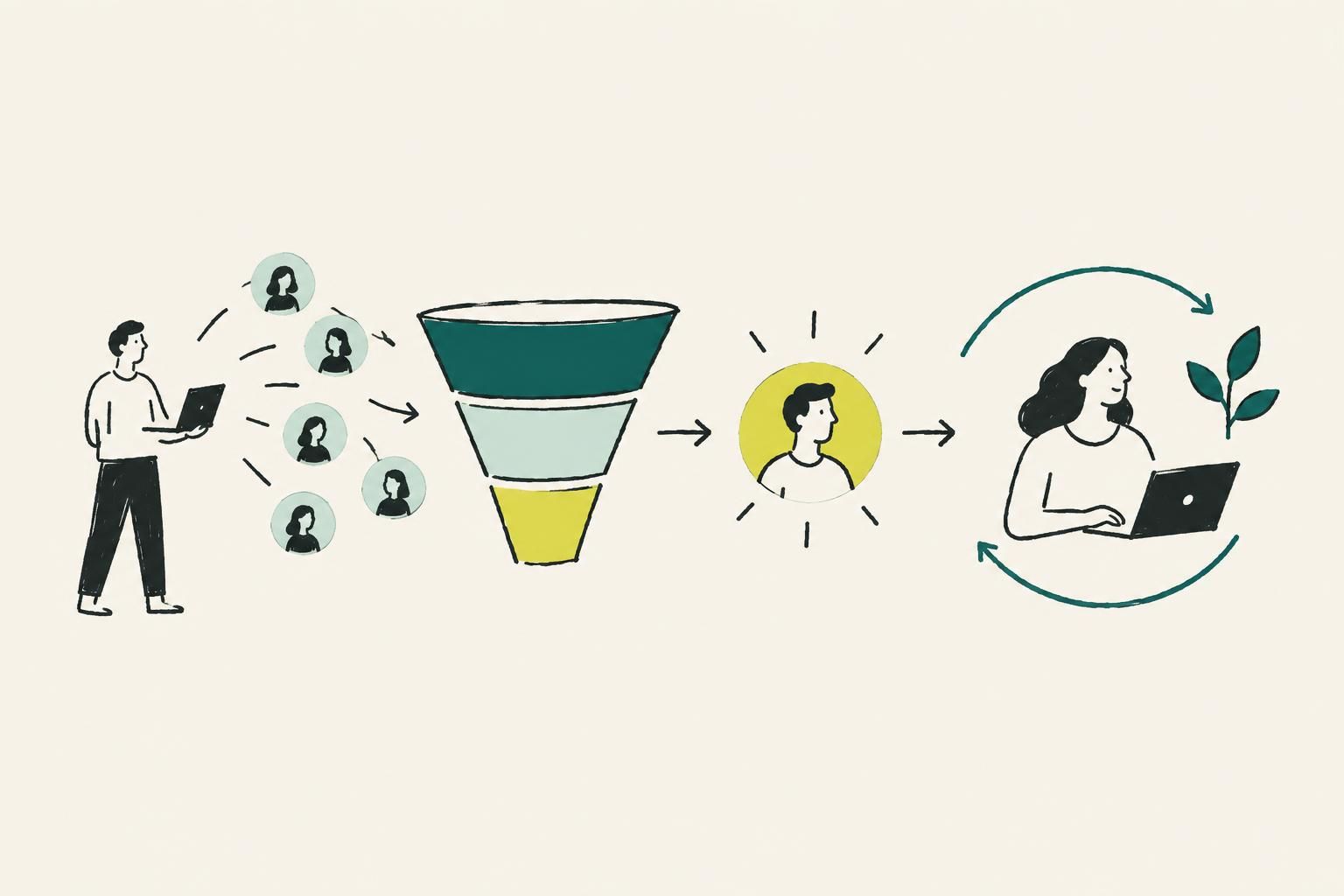
A revenue journey is more useful than a funnel diagram because it links marketing work to buyer progress. Plan for four jobs: create demand, capture active demand, help buyers evaluate, and improve activation and retention. Each job needs distinct pages, messages, and metrics.
Create demand where buyers do not yet know the category
Demand creation helps buyers name a problem before they are searching for a product category. Publish a strong point of view, teach a better operating model, show the cost of an old workflow, or share a useful benchmark from your own customer work. Founder-led posts, webinars, customer stories, partner appearances, and targeted social distribution fit here.
Keep the lesson specific. A vague claim that a market is changing creates little action. A detailed explanation of why a team loses hours at a particular handoff, plus a practical method to fix it, gives the right people a reason to revisit their process.
Capture existing demand with high-intent pages
Existing demand appears in searches and conversations where a buyer already has a job to solve. Build pages for category terms, use cases, integrations, alternatives, comparisons, templates, migration questions, implementation questions, and pricing-related questions that are genuinely relevant to your product.
Give each page one primary decision. A comparison page should explain meaningful differences and who each option suits. An integration page should describe the workflow. A use-case page should connect a specific team problem to a concrete outcome. Do not turn all of them into interchangeable product pitches.
Convert evaluation into a trial, demo, or sales conversation
Evaluation pages should reduce uncertainty, not merely repeat features. Show the first steps, expected setup work, compatibility constraints, examples of use, the available proof, and the next action. Match the conversion path to the product motion. A self-serve product needs a low-friction route to its first useful action. A complex sale needs a route to a well-prepared conversation.
Ask for information only when it improves the buyer experience or sales qualification. A long form placed before basic product understanding reduces learning. Use progressive qualification once the prospect has signaled real interest.
Treat activation and retention as marketing responsibilities
Marketing does not end at signup or contract signature. If customers do not reach an early value milestone, acquisition work becomes expensive churn replacement. Define the activation event that predicts meaningful use, then make it obvious through onboarding messages, in-product guidance, templates, implementation content, and customer success handoffs.
Retention also creates marketing inputs. Analyze why customers stay, expand, or leave. The answers improve your qualification criteria, product messaging, case studies, and roadmap. The most persuasive claim is often a pattern customers can verify from their own experience after adopting the product.
Choose channels by market signal, not by what is popular
Pick channels where your ICP already reveals intent or can be reached with a message that earns attention. A channel deserves budget after it produces learning about a segment, message, offer, or sales motion. It does not deserve budget because a competitor posts there every day.
SEO and educational content for compounding buyer intent
SEO is a strong fit when buyers search repeatedly for problems your product solves. Start with commercial and near-commercial topics, then use educational content to support those decisions. The goal is not to publish the most posts. It is to own useful paths from question to evaluation.
A practical cluster could include a category guide, several role-specific use cases, an implementation guide, integration pages, a comparison page, and a template. Link the pages according to the buyer’s next question. That structure helps readers find an answer and gives your commercial pages contextual support.
Paid search, paid social, and retargeting for faster learning
Paid search is useful where intent is explicit and the landing page directly answers the query. Paid social is better for testing messages, reaching a defined audience, and distributing a strong asset before search volume exists. Retargeting is useful after a prospect has taken a meaningful action, such as visiting a comparison page or starting a trial.
Run small tests with one audience, one message, one offer, and one landing page. Measure downstream quality, not only click-through rate. If paid traffic creates demos that never reach a qualified stage, the issue may be targeting, promise, page-message alignment, or sales follow-up.
Targeted outbound and account-based marketing for known accounts
Use targeted outbound when you can identify accounts with a plausible problem, a timely trigger, and a reachable stakeholder. Account-based marketing works best as coordinated account pursuit, not as a new label for sending more generic messages.
Build a short account list, research each account’s operating context, and offer a relevant observation or useful resource. Use marketing to warm the account with role-specific pages, customer evidence, events, or retargeting. Sales should follow up with a clear reason for the conversation.
Partner, integration, affiliate, and ecosystem marketing
Partners work when both sides serve the same buyer at adjacent stages of a workflow. Integration partners can produce co-marketed implementation guides, directory listings, webinars, and shared customer stories. Referral or affiliate arrangements need a clear audience fit and transparent incentives.
Start with one partner type and one repeatable asset. For example, create an integration page and a joint workflow guide for a complementary platform. If those assets create qualified conversations, build a broader partner motion. Do not collect logos before you have a shared route to demand.
Community, founder-led, and customer-led distribution
Founder-led distribution is especially effective when the founder has direct insight into the buyer’s work. Share hard-won lessons, product decisions, implementation mistakes, and useful frameworks. The standard is contribution, not constant promotion.
Customer-led distribution starts with customer outcomes. Invite customers to explain how they changed a workflow, not simply why they like the product. Community participation should follow the same rule: answer real questions, disclose your connection when relevant, and avoid treating every discussion as a lead list.
Create content that helps a buying committee make a decision
Good B2B SaaS content is decision support. It gives a buyer language for the problem, criteria for evaluating options, practical implementation guidance, and evidence they can bring to colleagues. It earns attention by being useful before it asks for a conversion.

Build a content portfolio instead of a blog full of generic posts
Build a portfolio across the journey. Include problem-framing articles for early research, commercial pages for active evaluators, product education for trial users, and customer proof for internal champions. Assign every planned page a target reader, a decision stage, an intended next step, and an internal link destination.
- Problem and category pages explain the cost, context, and approaches to a job.
- Use-case pages connect your product to a role, workflow, or outcome.
- Comparison and alternatives pages help active buyers evaluate trade-offs honestly.
- Integration, migration, template, and implementation pages remove adoption friction.
- Customer stories and proof pages help champions make the case internally.
Make SEO content useful in search and AI answers
Write for the reader’s underlying question, not for a keyword repetition target. Put the direct answer near the top, define terms precisely, use descriptive headings, show steps where steps matter, and separate facts from your interpretation. Support factual claims with credible sources and update pages when the product category or buyer question changes.
For buyer intent SEO articles, depth should come from decision-relevant detail. Include who a method suits, where it breaks down, what it requires, and what the reader should do next. That makes a page more valuable in conventional search results and more likely to be understandable when a reader encounters it through an AI-generated answer.
Decide whether to build, use software, or buy a managed content operation
Choose the operating model that matches your bottleneck. Build in-house when you have durable subject-matter access, editorial capacity, and enough volume to justify a process. Use self-serve software when your team wants direct control over generation and publishing. Buy a managed operation when strategy, research, writing, editing, and delivery are the missing capabilities.
| App | Best for | Platforms | Pricing |
|---|---|---|---|
| SEO for SaaS | Teams wanting researched, edited articles and same-URL content revisions, not high-volume hands-on generation control | Customer domain delivery through a read-only API, signed webhook, or review-first workflow | Pricing not publicly verifiable |
| The SEO Agent | Teams that want approval before articles publish | WordPress, Webflow, Shopify, Ghost, Wix, Webhook | $99/month for one site with 30 articles/month after the trial |
| LLaMaRush | Static-site teams that want GitHub-oriented publishing | WordPress, Ghost, Notion, GitHub | $79/month for 30 drafts and 30 AI header images/month |
| SEO WRITING | Teams that want a writing-first, self-serve workflow | WordPress, Shopify | Starter is $19/month or $14/month billed yearly for up to 50 articles |
| Machined | Teams planning large content clusters or using their own AI keys | WordPress, Webflow, Webhooks, Zapier, Make | Launch is $19/month for 30 articles; BYOK is $99/month for up to 2,000 articles/month plus provider costs |
SEO for SaaS provides a managed SEO content workflow with researched, cited, fact-checked, and edited articles. It uses a site or App Store listing plus keyword data for topic selection and can use Google Search Console data to identify posts losing clicks for same-URL revisions.
Use software instead when daily publishing volume, broad CMS integrations, or hands-on generation control matters more than editorial involvement. For example, LLaMaRush Founder costs $79/month for 30 drafts and 30 AI header images per month, supports daily autopilot publishing, and lists WordPress, Ghost, Notion, and GitHub support.
For a writing-first self-serve route, SEO WRITING Starter costs $19/month or $14/month billed yearly for up to 50 articles. Its Professional plan is $79/month or $59/month billed yearly for up to 250 articles.
For large content clusters, Machined’s Launch plan is $19/month for 30 articles. Its $99/month BYOK plan supports up to 2,000 articles/month, but requires customer-provided AI keys and separate provider costs.
Refresh underperforming pages before publishing more
Before adding another batch of articles, review pages that already earn impressions, clicks, trial starts, or assisted conversions. A page can underperform because its search intent no longer matches, its title and description are weak, its answer is incomplete, its internal links are poor, or its call to action does not match the reader’s stage.
Prioritize pages with demonstrated demand and a clear diagnosis. Update the substance first, then improve structure, links, proof, and conversion path. Preserve the URL when the topic remains the same, so existing links and search history continue to support the page.
Design the website and product experience to carry the marketing load
Your website is where marketing claims meet scrutiny. Make the homepage clear about the audience, problem, product, outcome, and next step. Then create routes for the questions that serious buyers actually ask: use cases, integrations, implementation, proof, security or reliability where relevant, pricing context where appropriate, and alternatives.
The product experience must continue the promise. If the marketing message promises speed, the first session should reveal a path to a quick win. If it promises better reporting, show the reporting workflow early. Marketing and product teams should jointly define the activation milestone and remove friction that prevents users from reaching it.
Set a budget and operating cadence that match your stage
Budget follows confidence. Early-stage teams need inexpensive learning cycles before large commitments. Mature teams with a proven segment and conversion path can invest in scale, but even then, each channel needs a clear owner, operating cadence, and measurement standard.
What bootstrapped teams should do first
Start with customer conversations, a focused ICP, a clear homepage, a small set of high-intent pages, and a reliable onboarding path. Choose one distribution channel where you can learn quickly: targeted outreach, founder-led distribution, search-focused content, a partner relationship, or narrowly targeted paid search.
Set a weekly cadence: review customer feedback, publish or improve one decision-relevant asset, distribute it deliberately, and inspect pipeline quality. Avoid buying several tools or hiring several specialists before you know which message and segment produce qualified interest.
When to add specialists, agencies, or automation
Add help when the bottleneck is known and repeatable. Hire a specialist when a channel already works but lacks expertise or execution capacity. Use an agency or managed service when the operating system is clear but your team cannot staff it. Use automation when the task has enough structure that automated output can be reviewed reliably.
Compare plans by operating fit, not article count alone. RankYak Pro costs $99 per site/month and provides one article per selected publishing day, which is about 21 monthly on weekdays or about 30 monthly on every day. That schedule-based allowance is different from a bank of articles to use at any time.
Measure B2B SaaS marketing from first touch to retained revenue
Measurement should connect attention to commercial outcomes. Define a small set of lifecycle stages, document what qualifies movement between stages, and use the same definitions across marketing, sales, and customer success. This prevents one team from celebrating leads while another sees no pipeline.
Track leading indicators without mistaking them for growth
Leading indicators reveal whether the system is working before revenue has time to mature. Track relevant search impressions, rankings for commercial terms, qualified website visits, return visits, content-to-demo paths, trial starts, activation rate, target-account engagement, and sales conversations with the right segment.
Use these metrics diagnostically. More traffic with flat qualified conversion suggests a targeting or page problem. More trials with weaker activation suggests an onboarding or qualification problem. More demos with low opportunity creation suggests the offer or sales handoff needs work.
Track the SaaS economics that determine whether a channel can scale
Track customer acquisition cost by channel, conversion rates between meaningful stages, sales cycle length, payback period, customer retention, expansion, and the revenue retained from each cohort. Pair each channel’s spend with the revenue quality it creates, not just the number of contacts it creates.
For content, connect pages to assisted pipeline and eventual customer quality where your data allows it. Some articles will influence a buyer before a direct conversion. That does not make all content valuable. It means you need a consistent attribution approach and periodic qualitative review of what prospects actually consumed.
Common B2B SaaS marketing mistakes and how to correct them
- Mistake: targeting every company that could use the product. Correction: choose the segment with the clearest pain, strongest proof, and fastest route to learning.
- Mistake: publishing broad educational posts with no commercial path. Correction: connect education to use cases, comparison criteria, implementation guidance, and relevant next steps.
- Mistake: optimizing only for lead volume. Correction: review qualification, activation, retention, and revenue by source.
- Mistake: treating a feature list as positioning. Correction: explain the costly problem, the differentiated mechanism, and the outcome for a defined buyer.
- Mistake: automating publication without a quality standard. Correction: set editorial requirements for accuracy, relevance, internal links, source use, and conversion intent.
- Mistake: adding new content while valuable pages decay. Correction: review and improve pages with existing demand before expanding the library.
A 90-day B2B SaaS marketing plan for an early-stage team
Days 1 through 30: interview customers and recent prospects, choose one ICP, map the buying committee, write the message hierarchy, define activation, and audit the website. Publish or rebuild the homepage, one core use-case page, one proof page, and one high-intent page that answers an active buyer question.
Days 31 through 60: choose one primary acquisition motion. Build a short content cluster around a commercial topic, run a tightly scoped outbound or paid test, or launch a partner asset. Add instrumentation for source, conversion stage, and activation. Review each week for message resonance and lead quality.
Days 61 through 90: improve what produced qualified signals. Refresh the best pages, strengthen internal links and calls to action, create sales enablement from recurring objections, and document the operating cadence. Cut activity that generates attention without progress. End the quarter with one repeatable motion, not a longer list of disconnected tactics.
FAQ about B2B SaaS marketing
Is B2B business still good in 2026?
B2B remains a viable model when a company solves a costly, persistent business problem for a defined buyer and can acquire, activate, and retain customers at sustainable economics. The opportunity is not a guarantee. Validate demand through customer conversations, qualified pipeline, activation, and retention before scaling spend.
What is the 3-3-3 rule for marketing?
There is no single universal 3-3-3 rule for marketing. The phrase is used for different frameworks. Do not adopt it as a strategy without defining the version, the buyer problem it addresses, the metric it should improve, and the test period.
How much do B2B marketers make?
B2B marketer compensation varies by role, experience, location, company stage, responsibilities, and the structure of salary, bonus, or equity. Compare roles with the same scope and market rather than relying on a single generic figure.
Is ChatGPT a SaaS?
ChatGPT is delivered to users as an online software service, so it can be described as SaaS in the broad sense. That label alone does not explain a B2B product’s marketing strategy. A SaaS company still needs to define its buyer, use case, purchase motion, and retention model.

Conclusion: Make marketing a repeatable part of how your SaaS grows
The strongest B2B SaaS marketing systems are built from evidence: a narrow ICP, validated language, a complete buyer journey, disciplined channel tests, and measurement tied to retained revenue. Start with one segment and one repeatable motion. Improve it through customer feedback and performance data, then expand with confidence.