
Recurly’s 2024 State of Subscriptions report puts the median trial-to-paid conversion rate at 50.0% for 2023. Recurly defines that metric as the proportion of trial users who become paying subscribers. Content earns its budget when it helps the right prospects reach the product actions that lead to that transition.
For a lean SaaS team, the priority is a narrow system: one ICP’s revenue-critical problem, searchable decision content, product and customer proof, then lifecycle help that improves customer outcomes. Use free Search Console and customer interviews to validate demand. SEO for SaaS, made by this site’s publisher, produces and refreshes researched buyer-intent SEO articles on your own blog. It is useful for turning validated opportunities into published search content, but it does not replace product-led lifecycle messaging or distribution.
Treat publishing volume and traffic as diagnostic signals, not the score. Assign every content play to a buying or customer action, then scale, refresh, or stop it based on attributable pipeline and product progress.
Choose one revenue problem
Start with one business outcome, one ICP buying context, and one triggering problem. “Operations leaders at multi-site manufacturers need a defensible maintenance-system comparison before a renewal” is more useful than “industrial buyers” or “post on LinkedIn and the blog.” It gives content a defined objection to resolve and a commercial event to influence.
Document the buyer’s current workaround, the cost of leaving it in place, the stakeholders involved, and the product behavior that signals early value. Build detailed segmentation with this guide to ICP marketing for SaaS, then turn that definition into a focused editorial plan with a SaaS content strategy.
Keep the first quarter of work centered on that problem. A defined problem prevents a small team from spending its limited production capacity on adjacent keywords that attract readers with no reason to evaluate the product.
Find decision-led search demand
Prioritize questions that arise during a decision: problem diagnosis, comparisons, alternatives, integrations, implementation steps, security requirements, and migration concerns. These topics put the product beside a concrete job the buyer is trying to complete, rather than chasing a large but loosely related audience.
Google says its ranking systems prioritize helpful, reliable information created to benefit people. It also identifies publishing lots of content across many topics in the hope that some will rank as a search-engine-first warning sign, and says it has no preferred word count. Build a small cluster that answers genuine buyer questions with product-specific detail. Google’s helpful-content guidance supports depth of usefulness over a volume target.
For existing content, open Search Console Performance. In Queries, sort by Clicks, CTR, or Impressions. In Pages, choose Clicks and sort by clicks. Google defines CTR as clicks divided by impressions, while average position is the topmost position of a property or page averaged across searches where it appeared. Use those views to find pages with demand but weak clicks or pages already drawing relevant queries, then improve the page that exists instead of creating another broad article. Search Console’s Performance report provides the workflow.
Interview founders, sales calls, support teams, and customers alongside that data. Ask what prompted the search, what alternatives were considered, and what stopped implementation. Then commission only the articles that answer repeated, commercially relevant questions. For a fuller process on matching search topics to buyer intent, use this SEO content marketing guide.
Map assets to lifecycle
Every asset needs one audience, lifecycle stage, product goal, and next action. Problem education belongs in awareness. Comparisons, alternatives, and proof belong in consideration. Implementation, migration, and security answers support purchase. Onboarding guidance supports activation. Advanced workflows and use cases support retention and expansion.

HubSpot’s default Lifecycle stage property uses Subscriber, Lead, Marketing Qualified Lead, Sales Qualified Lead, Opportunity, Customer, Evangelist, and Other. Use that sequence as shared vocabulary between marketing, sales, and customer success. HubSpot’s lifecycle-stage documentation explains the progression.
| Topic | Stage | Owner | CTA | Distribution reuse | Success event |
|---|---|---|---|---|---|
| CMMS alternatives for multi-site teams | Consideration | Founder or product marketer | Request a demo | Sales follow-up | Demo request |
| Security and implementation guide | Purchase | Product and security lead | Start a trial | Sales enablement | Trial start |
| First-team workspace setup | Customer | Customer success | Invite a teammate | Onboarding email | Activation event |
| Advanced reporting workflow | Customer | Product marketer | Use the feature | In-product education | Expansion signal |
Run this table as the editorial calendar. It forces a useful decision before production: what customer action should change if this asset works? Remove topics that have no credible answer.
Make proof hard to copy
Generic keyword coverage is easy to match because competitors can answer the same question. Add evidence that comes from operating the product: named SME review, workflow screenshots or demonstrations where appropriate, implementation detail, customer results, and clear limits. These elements address the risk questions that surface during evaluation.
Wingify reported that an A/B test for Bandwidth’s SMS API product page ran for about 60 days with approximately 3,500 visitors. A variation combining customer logos with a revised hero and value proposition produced a 12% jump in visit-to-lead conversion rate over the control. The test bundled changes, so it does not isolate logos as the cause. It does show why proof should sit near the decision and the CTA rather than live in a separate testimonial page. Wingify’s Bandwidth case study documents the result.
Use subject-matter experts to check technical claims before publication. RevenueZen’s Carevoyance case study combined healthcare and medical-technology SME-written content with technical fixes, syndication, paid social, CTA work, and outbound lead generation. The company recorded an 830% increase in SEO-sourced qualified leads within 12 months, so the result is evidence for an integrated program rather than proof that publishing alone caused it. Put SME time into the pages that answer implementation and risk objections first.
Publish once, distribute selectively
Make the owned article or resource the canonical asset, then reuse it only where the chosen ICP already needs that information. Turn an implementation guide into a sales answer for an active opportunity, an onboarding email for a new trial, a founder post that frames the problem, a partner resource, or an in-product help link. Each reuse needs a distinct lifecycle job and a next action.
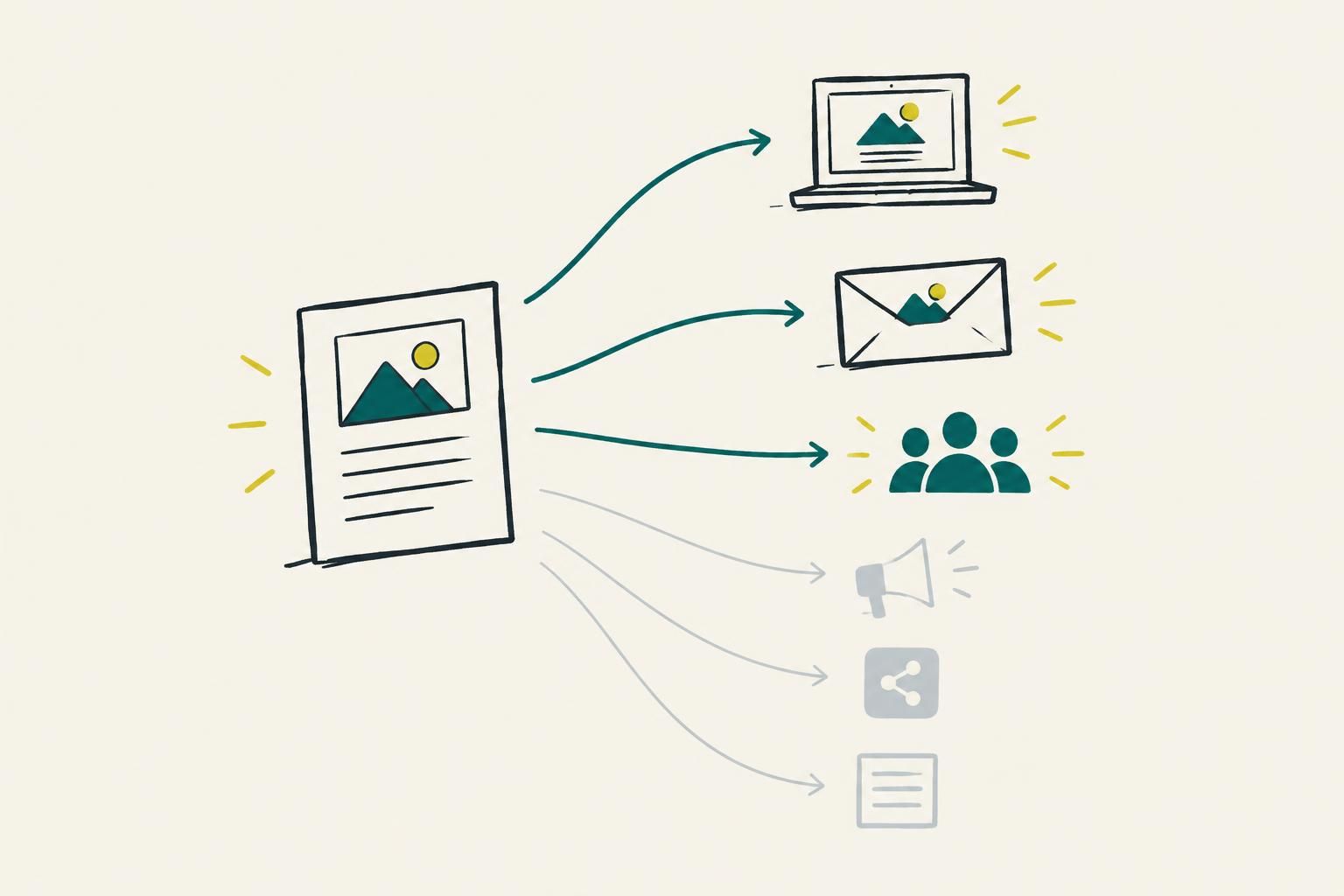
Stop maintaining formats that create impressions without advancing a useful action. A founder social post that sends qualified readers to a comparison guide has a job. A channel maintained because competitors publish there does not. Keep the source asset current, so sales, success, and marketing all send prospects to the same accurate explanation.
Measure business events
Measure demo requests, trial starts, sign-ups, activation events, purchases, and expansion signals alongside impressions, clicks, and CTR. In GA4, go to Reports, Engagement, Events, find the event row, select the 3 dot icon, and choose Mark as key event. Google says any collected event can become a key event, and event data can take up to 24 hours to appear in the Events report. GA4 key-event instructions provide the current route.
Declare the attribution rule before calling a play pipeline-generating. GA4 offers Data-driven attribution, which distributes credit using the property’s data, and Paid and organic last click, which assigns all credit to the last non-direct interaction before the key event. Use one model consistently in the review period, then compare content by attributable opportunities, activated trials, and revenue-related events rather than by sessions alone.
For new or substantially updated URLs, validate indexing with Search Console’s URL Inspection tool. Google says crawling can take from a few days to a few weeks; Request Indexing is quota-limited, and repeated requests do not speed crawling. For substantially similar republished pages, use a rel="canonical" link pointing to the preferred URL and a self-referential canonical on that page. Google’s indexing guidance explains the timing and request limits.
Review each play after one typical sales cycle and the minimum volume of qualified visits, trials, opportunities, or customer events you set before publishing. Scale assets that bring the right trials and improve activation. Refresh pages with relevant impressions but weak clicks or stale proof. Stop assets that attract the wrong audience or fail to move a defined event after that review point.
Recurly’s 50.0% median is not a universal target because trial design and payment mechanics must be comparable. Use your own stable trial-start cohort as the denominator, then invest in the content plays that improve the customer actions leading to paid use.